Showing posts with label obesity. Show all posts

Tuesday, November 20, 2012

What's bugging your gut, part 3: Entamoeba histolytica


File:Entamoeba histolytica 01.jpgConsidered pathogenic, this amoeba is a single-celled organism that constantly changes shape. It is pathogenic and can infect the intestines as well as other organs (via the blood-stream) such as the liver.
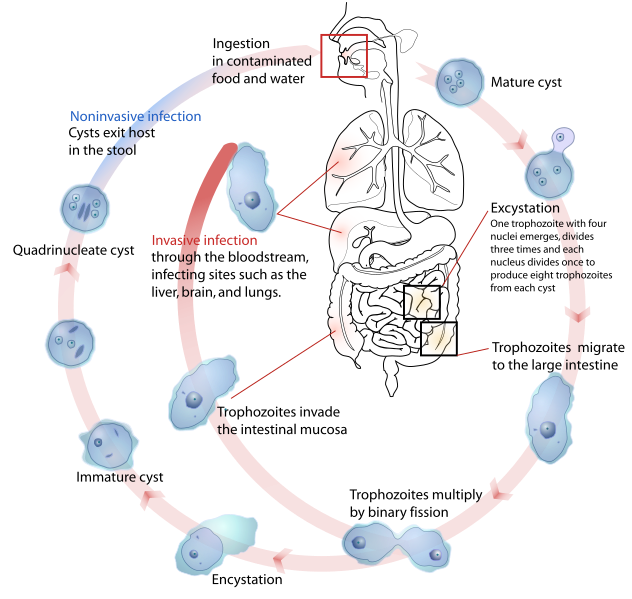
Transmission of this bug is usually through faecally-contaminated food, water, or hands, as the cysts are passed in faeces and can survive in the environment outisde of the host for anywhere from days to months. Once the cyst is ingested, the trophozoite is released into the intestinal tract where it can bore into the intestinal lining and cause symptoms, even going further and ending up in the blood-stream, where it will be deposited into other organs, such as the liver, lungs, brain, spleen, etc. It is found using a stool test.


File:Entamoeba histolytica life cycle-en.svgSymptoms include a gradual onset of abdominal pain, diarrhoea, weight loss, fatigue, and bloody stools. In severe cases, fever and dysentery can be found. When deposited into the liver, it causes amoebic liver abscess, which can be fatal if left untreated. it is not uncommon for Inflammatory Bowel Disease (IBD) to be diagnosed when actually, this little bug is the poblem.

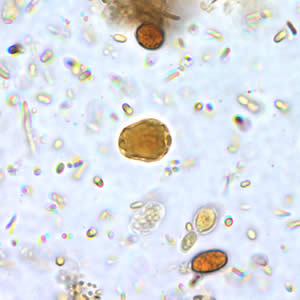
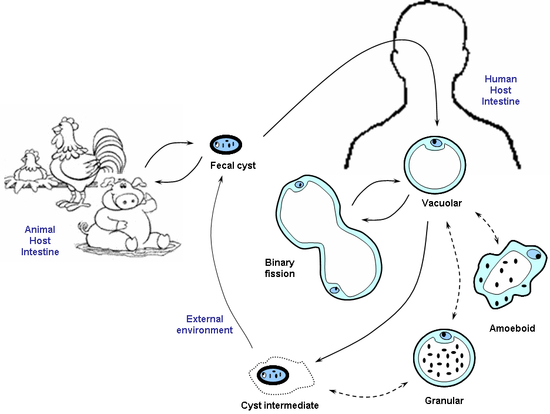
Like other intestinal parasites, this amoeba can be treated using pharmaceutical anitbiotics, however herbal medicine can also be beneficial, used in the appropriate dosages and in the appropriate manner. The standard protocol of clearing the gut and boosting the immune system using medicinals such as Chinese wormwood, Black walknut, cloves and turmeric. The gut then needs to be re-built using pre- and pro-biotics.

To make abooking to have your digestive system brought back into harmony, call Discover Chinese Medicine on 03 9013 1777, or click here to make an online booking.

Saturday, November 3, 2012

Get your Mo on for men's health!

It's that time of year again when men around town start sporting odd-looking facial hair, looking like someone out of a barbershop quartet or a bikie!

No, it's not a cyclical trend of course - it's Movember, where men grow moustaches in support of promoting men's health. The global, month-long charity which had its humble beginnings in Melbourne specifically raises money for research and awareness into prostate cancer and male mental health.

The statistics are quite frightening,  with rises in the diagnosis and treatment of depression (linked inextricably to incidences of suicide in seemingly-happy males). Male life expectancy is about 5-6 years less than women; The suicide rate in males is four times higher than women; and it is estimated that five men die prematurely each hour from potentially preventable illnesses.

The Movember movement has shown to be effective not just in raising awareness about andrological health in mens' minds, but also in making significant changes in their lifestyle - the most important being actually visiting a doctor and getting a health check! As I've written on this site before, men are often reluctant in going to see a doctor in order to get checked out, let alone if they are actually starting to feel sick. Prevention is far better than the cure, not just for the individual, but also is thought to significantly make a difference to the national budget on health and take the strain off an already struggling health system.

Chinese Medicine of course has as its fundamental axiom the principle of preventing disease before it happens. The idea of treating sickness was likened to trying to fill a well when the village is dying of thirst. With our unique diagnostic system, such as the observation of the pulse, the examination of the tongue, palpation of the channel system, and the interpretation of various signs and symptoms as part of a larger 'pattern', we are able to gain subtle insights into the state of an individual's health. Often, some of these signs reveal the beginnings of more serious conditions, signs that the average person wouldn't think twice about, or consider a sign of becoming something more serious.

These Signs include constant headaches, persistent lower back pain, dribbling after urination, decreased libido or sexual function, feelings of discontent, waking up tired, unable to fall asleep, bloating after meals, changes to regular bowel habits, putting on weight, constant irritability or short tempers, greying and loss of hair, inability to cope with stress, feeling overwhelmed, rib-side pain, acid reflux, indigestion, shoulder and neck tension, recurring colds and 'flus, and so on.

On their own, these things seem innocuous and harmless. But when there is a pattern of these symptoms occurring more than once or twice, they point to what Chinese Medicine practitioners refer to as a 'pattern of disharmony'. A presenting pattern may be nothing that causes a disruption to one's normal daily routine, but if left unaddressed it can progress on to other more serious and chronic conditions.

Being able to see these patterns and treat them is part of the preventative process. Treating these disorders gently and natural with Chinese herbal medicine and acupuncture means reversing the disharmony gently, and then building the body, mind, and emotions up to be strong. Strength in men is important, as it allows us to be authentic individuals, to bring out our natural protective tendencies and to hold the space effectively for our wives, sisters, daughters, and mothers.

So whilst your grow your Mo this Movember, don't forget to come into the clinic for some preventative acupuncture and Chinese herbs. Take control of your health, your body, mind, and spirit, and start your new life with good health and happiness.

Click here to make a booking with our practitioners at Discover Chinese Medicine.

Wednesday, September 26, 2012

What's bugging your gut, Part 1: Blastocystis hominis


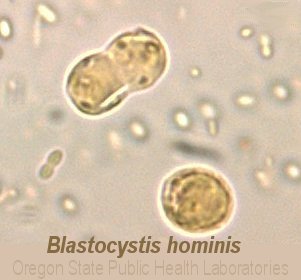
Blastocystis hominis is a small protozoal parasite that lives within the mucus of the large intestine and the colon, sticking to the inner wall, thus making it extremely difficult to get rid of even with extensive medication.

It is transmitted via the faecal-oral route, or from contaminated food or water. Incidence of B.hominis is therefore quite high in developing countries; however the incidence in developed countries is great amongst those with regular exposure to animals.

Part of the problem of this parasite is that many people may have them, but present with no symptoms whatsoever. For the most part, it is thought to not really be a problem in health unless someone later develops a problem with the immune system or the digestive system. The usual signs of infestation include anal itching, diarrhea, excessive flatulence, weight loss, on-and-off abdominal pain/cramps, abdominal distension, bloating and discomfort, constipation, diarrhea, nausea, intense brain fog, very low energy levels, lack of concentration, lack of appetite at times but increased cravings at other times and strangely enough weight gain. Those who suffer from allergies, immune system difficulties, skin problems, and bowel problem should also suspect that B.hominis may be causing problems.


The only true way to determine if the parasite exists in significant numbers in your gut is to get a digestive stool analysis which includes testing for parasites (not all stool testing is the same). These tests usually have a turnaround time of 1-2 weeks, depending on the pathology service.

Whilst mainstream medicine will prescribe strong anti-biotics, this is often found by some patients to be ineffective. There are natural medicine treatments that do work in reducing the severity of the parasite, with treatment protocols that can take 1-2 months.

There are certain Chinese medicine herbs that research has shown to be useful in clearing the gut of these parasites - which, according to traditional Chinese Medicine diagnostic approaches, are also generally indicated for the types of patterns one expects to find with the above signs and symptoms:
  • Huang Lian (Coptidis rhizome)
  • Huang Bai (Phellodendron rhizome)
  • Huang Qin (Scutellaria rhizome)
  • Ya Dan Zi (Brucea seed)


These herbs are all noted to 'clear Damp-Heat & Toxicity', which many of the above signs correlate to, and lack the harsh side-effects that powerful anti-biotics usually have. Some other herbs that are used include Black Walnut and Wormwood, Oregano oil, Thyme oil, and Clove oil. These herbs all need to be prescribed in the correct dose to be truly effective.


Some other treatments known to be effective include:
  • Less/No-grain diet: B.hominis is known to thrive on the the carbohydrates from grains, as well as sugar.
  • Colonic irrigation/enema with herbs that are focussed on killing the parasite.
  • Highly effective fat-digesting enzymes - this parasite is known to be built with fats; the dissolution of fats weaken and kill it.
Once the parasite has been cleared out of the system, we have found that the gut needs repairing, and this is done using specialist probiotics. The course of treatment can be repeated a couple more times, with re-testing to confirm how much of the parasite has been cleared.

There may still be a need for other herbal formulas to treat other aspects of illness/disharmony, and this is where the power of Chinese herbal prescriptions comes into its own, further strengthening and healing the digestive system after B.hominis infestation, and the clearing treatment. Herbal medicine is prescribed for the person, attending to redressing any energic imbalance also.

Patients often remark how the usual milieu of digestive complaints disappear once this parasite is no longer in their digestive tract.


Friday, July 6, 2012

Do you have the gall to keep your gallbladder?


It is becoming increasingly more frequent that people are having their gallbladders surgically removed. This is usually due to the advise of a medical practitioner (usually a surgeon) who recommends it as a first course of treatment in cases of gallstones (cholelithiasis) and with “sluggish” gallbladders, or gallbladder inflammation (cholecystitis). Most people in this situation are told that it is perfectly alright for this to happen, and most are under the impression that the gallbladder has no real necessary function in the human body.

This could not be further from the truth. What's more, the procedure of removing the gallbladder would be considered a last resort, when all other methods have failed.

The gallbladder indeed has a very important function as part of the digestive system. Its role is to store a substance called Bile, and to secrete it into the small intestine during digestion. Bile is an alkaline substance, bitter-tasting and greeny-yellow, containing acidic bile salts, cholesterol, bilirubin, electrolytes, and water. Its main role is in the emulsification and absorption of dietary fats. The storage of bile in the gallbladder occurs between meals, removing the water and electrolytes, and storing it in concentrated form, to then be released about 30 minutes after a meal. When dietary fats are present in the duodenum (the upper part of the small intestine), hormonal signals are sent to the gallbladder to begin secretion.

If the gallbladder is removed, it becomes near-impossible to digest any form of dietary fats, requiring one to be on either a no-fat diet, or very small amounts eaten regularly. Dietary fats are required for the operation of the endocrine system (hormones); they provide the pre-cursors to many of the sex-hormones in the form of cholesterol; and they are also important for the absorption and metabolism of important fat-soluble vitamins and minerals. The gallbladder is necessary for dietary fats to be absorbed by the body, so that the endocrine system can perform its role in healing the body when necessary.

In symptomatic cases of gallstones, there is considerable localised abdominal pain and jaundice. Other signs and symptoms of gallstones could include heartburn, flatulence, epigastric discomfort, and intolerances to fatty foods and cabbage. An inflamed gallbladder is usually caused by the lodging of a gallstone in the cystic duct. The pain is similar but will present with specific findings of test results.

In Chinese Medicine, the gallbladder is also said to have a psycho-emotional role, allowing us to be courageous, and having the courage to express our innermost desires in the external world. This is recognised by many other cultures also, with the common expression “having the gall” to do/say something with a degree of audacity. Confucian medical scholars likened the gallbladder to the social role of the judge, whose job it is to make decisions and carry out the (legal) decisions of the State. Thus indecisiveness is said to indicate a weakness of the gallbladder, whilst to have 'da dan' (a large gallbladder) indicates that someone is courageous and decisive.

So how can Chinese Medicine help with gallbladder disorders? Using acupuncture, herbal medicine, and dietary therapy, practitioners are able to dissolve and clear gallstones. Often gallstones are asymptomatic, so if there appears to be some issues with digestion (especially involving foods with considerable levels of dietary fats), it is often useful to do a “gallbladder flush”, which helps clear the ducts that carry bile, and dissolve and clear any stones that are yet to be big enough to cause pain or complete blockage. There are very effective herbal formulas which dissolve the stones, and then flush them out. Apple cider vinegar and artichokes are known to be useful for this, as are lemons, limes, turmeric, parsnips, radishes, mung beans, rye, endives, linseed oil, chamomile tea, and seaweed.

It is a better idea such non-invasive and less-radical procedures to clear the gallbladder of stones and inflammation before heading down the route of surgical removal. The gallbladder has an important function in digestion, and it is probably worth the effort to keep it.

Friday, July 1, 2011

DAMP. What is it. How did I get it. How do I clear it.

You may have heard the Chinese Medical term 'Dampness'.  What exactly is damp? How did it get there, and how do you get rid of it?

Internal dampness is directly due to the impaired transformative and transportive function of the digestive organs which results in some form of pathogenesis within the body, organs and meridians. Dampness can be thought of as the condition of "high humidity" inside the body.

A Damp condition creates symptoms of sluggish energy, a tendency to gain weight, a feeling of heaviness in the body, joints and or head, swelling or water retention, distended abdomen, sticky stools, loose bowels, phlegm discharge from lungs or nose, nodular masses, a sound of water sloshing in the stomach and or stomach rumblings, sores, weeping eczema, profuse purulent leukorrhea, turbid urine and stools containing mucus, no thirst, fatigue, and the tongue is often puffy with teeth marks and a greasy tongue coating at the back of the tongue. In Chinese Medicine, dampness is considered to be the cause of many illnesses such as high cholesterol, cancer, metabolic disorders, chronic fatigue syndrome, Candida, Herpes outbreaks, fibromyalgia, allergies and environmental illness.

A collection of dampness over long periods of time generate heat to build in the body due to the nature of damp blocking Qi and blood flow. The damp and heat mixed together may lead to such problems as inflammation, allergies (especially food allergies), high blood sugar, weight gain, and urinary tract infections. Symptoms can include heaviness, a sensation of fullness in the chest, a smelly and sluggish bowel, abdominal pain, leukorrhea, eczema, and deep yellow colored urine. The tongue is commonly has a greasy coating.


Raw food is a controversy to Chinese medical practitioners. Traditional Chinese doctors work on the principle that raw food may be full of vitamins nutrients, however raw food can be very hard to digest and absorb these nutrients. This is the reason why we do not feed young babies raw food. Everything we feed a baby is cooked, warmed and soft. Baby food is easy to digest and thus nutrients are easily extracted.When the digestive system is not firing properly it is better to stay away from raw food until the digestive system has gained strength, this is especially true for anyone suffering from a damp condition. It is better to eat food that is is easy to digest and warming in nature.

What should I eat? Food Therapy for Dampness & Phlegm -

General Principles:

•    Ideal cooking methods are steaming, boiling, grilling, soup. Ideally always eat cooked meals that are warm when you eat them.
•    Avoid sugar, concentrated sweeteners, high glycemic index foods, yeast (check labels especially if you have Candida signs), alcohol and fruits except citrus and berries.
•    Avoid raw foods including salads and raw fruit (whole or juiced) until damp has cleared and digestion is stronger.
•    Eat a whole food diet and remove foods that are difficult to digest such as milk products, (small amounts of yoghurt are ok) soy milk, animal fat, greasy foods, and food and liquids that are cold in temperature ie. Icy or cold drinks, especially beer. (this also means we say good bye to ice cream)
•    Eat regularly, avoiding heavy meals especially in the evening
•    Eat rich, nutritious meals in small quantities that are well distributed throughout the day.
•    Eating on the run or when you’re stressed creates dampness as digestive enzymes are low or not available at these times. Food banks up when we eat at these times.
•  Limit the intake of nuts. Sunflower seeds, pumpkin seeds, walnuts and almonds are less congesting however.
•    Worry, pensiveness and mental overwork often negatively affect the transporting and transforming function of the Spleen and contribute to deranged water metabolism as internal dampness. Take a deep breath, and spend a little quite time alone or start a meditation practice.
•    Overeating creates dampness due to food backing up. Eat until your 80% full.
•    Regular stretching and exercise (eg yoga) is an essential part of treatment
•    Increase the amount of mild spices in the diet (not chilli)
•    Avoid deep fried and ‘junk’ food
•    Avoid wheat and gluten products (wheat, rye, oats, barley)
•    Vinegar, mushrooms, fermented foods can also create damp – avoid if you experience Candida
•    Watch your Vitamin C intake, over 1-2g per day can contribute to dampness.
•    Avocado, banana and tropical fruits are absolutely forbidden in the morning.

Beneficial foods:

Vegetables: Pumpkin, sweet potato, celeriac, squash, zucchini, carrot, parsley, Include all green leafy vegetables: broccoli, bok choy, cauliflower, brussel sprouts

Protein: chickpeas, black beans, yam, peas, walnuts, chicken, beef, lamb, liver, kidney, tuna, mackerel, anchovy

Beneificial spices:  Onion, leek, garlic, turnip, fresh ginger, cinnamon, nutmeg, fennel, cumin, coriander, cardamom, star anise, turmeric. 

Drinks: green tea, lemongrass and ginger

Unfortunately a Western diet is damp in nature. You may feel like you have to completely revolutionise your diet and lifestyle to get rid of Damp. All Western students of Traditional Chinese medicine thought the same thing when they found out about damp too. But once you make the change to a non damp diet you will feel younger,  look younger, loose weight, your skin will thankyou and you will feel energised, refreshed and liberated.

If this information is too much or confusing don’t opt out, just simply stick to a Japanese diet (except the tempura) and you’ll be fine.